Wilderness Alternative Expedition guide to Samburu, Buffalo Springs and Shaba
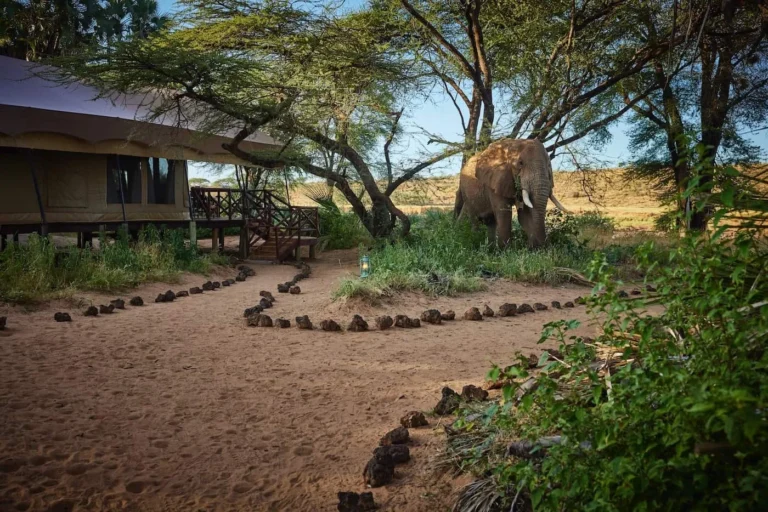
Northern Kenya announces itself before the first elephant appears. The air is warmer and drier, the road falls away from Mount Kenya’s high country, and the vegetation opens into thorn scrub, ochre earth and sudden rock. Then the Ewaso Nyiro cuts a green line through it all. Doum palms lean over the banks, elephant paths descend into the sand, and wildlife gathers around water that can change from a broad brown current to isolated pools and hidden seepage beneath a dry riverbed.
Samburu, Buffalo Springs and Shaba are often sold under the single name “Samburu”. They belong in one journey, but they are not one reserve. Samburu lies on the northern bank of the Ewaso Nyiro. Buffalo Springs occupies the southern side and opens into drier plains around its springs. Shaba sits farther east, a more rugged volcanic landscape with broader horizons and usually fewer vehicles. A well-built safari uses those differences rather than repeating the same game drive on three maps.
The river that organises the safari
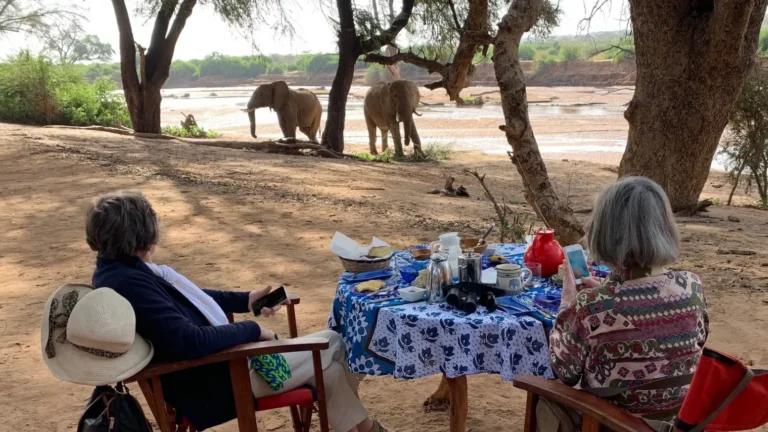
The Ewaso Nyiro is the ecological spine of this region. In a semi-arid landscape, its riverine woodland provides shade, forage and access to water for elephant, buffalo, antelope, primates, birds and predators. The river is also variable. Rain falling far upstream around the Aberdares and Laikipia can affect its flow here; in hard dry periods, surface water may retreat or disappear in sections. Elephant dig into sandy beds to reach subsurface water, creating temporary wells used by other animals.
This variability is not scenery alone. It shapes where wildlife moves, how pastoral communities manage livestock, where predators wait and which tracks remain passable. It also means a guide must read the current season. The most productive drive may follow the river at dawn, search open country for Grevy’s zebra and oryx later, or abandon a planned route because recent rain has changed a crossing.
Samburu National Reserve: riverbank drama
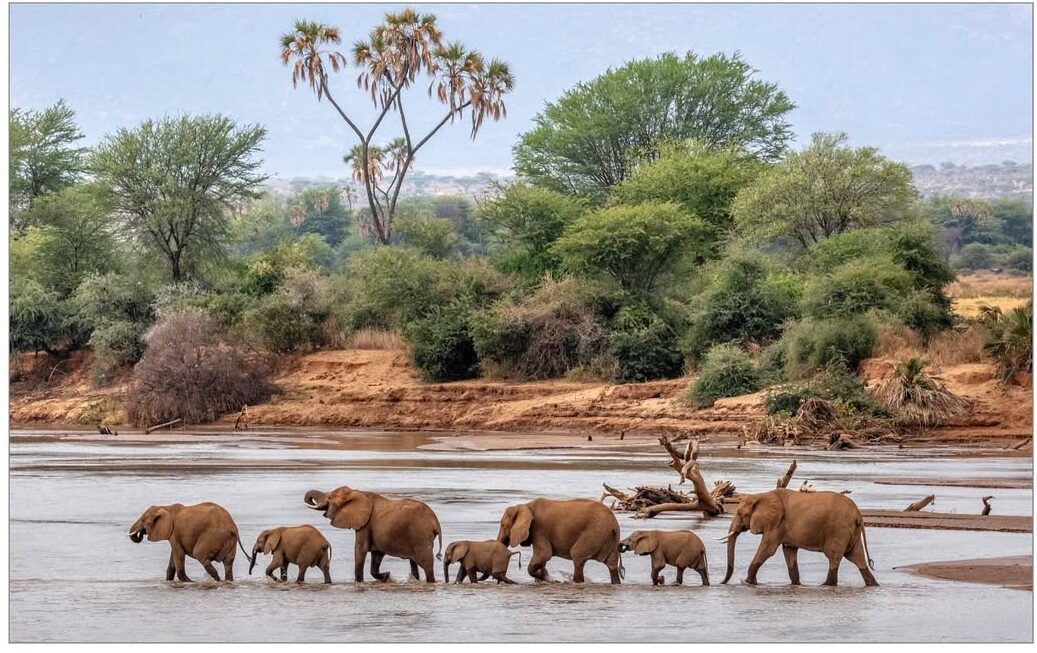
Samburu National Reserve covers roughly 165 square kilometres on the northern bank. It contains the region’s strongest concentration of established camps and game-viewing tracks, with a landscape of doum-lined riverbank, acacia country, grassland and rocky outcrops. Elephant are central to the experience. Families may arrive quietly through the woodland, drink at close range and climb the opposite bank in a line, each calf held within the judgement of older females.
The river corridor is also good leopard country, though a leopard is never owed to a visitor. Lion use shade, cover and the movement of prey towards water. Away from the river, the reserve becomes a place of distance and dry-country detail: a gerenuk rising on its hind legs to browse, a vulturine guineafowl troop moving through dust, or a Grevy’s zebra whose narrow stripes and white belly separate it from the more familiar plains zebra.
Samburu is the most logical base for a first visit and often the busiest of the three reserves. That makes timing important. We leave early, use quieter loops where conditions permit and resist joining a queue simply because several vehicles have stopped.
Buffalo Springs: open country south of the river
Across the Ewaso Nyiro in Isiolo County, Buffalo Springs changes the visual rhythm. The country feels broader and more exposed, with dry plains, scrub, lava-influenced ground and the springs from which the reserve takes its name. When crossings and gate arrangements allow, combining both riverbanks gives more than extra mileage: it changes backgrounds, light direction and the wildlife one is likely to find.
Buffalo Springs can be rewarding for reticulated giraffe, Beisa oryx, Somali ostrich, Grevy’s zebra and predators using open ground. Its pools and wetter patches draw birds and animals, while the southern perspective can produce fine views back towards the northern hills. It can also feel hot and apparently empty in the middle of the day. That emptiness deserves patience. Northern wildlife is adapted to space, heat and patchy resources; it does not arrange itself continuously along a tourist road.
Shaba: volcanic space and a slower mood
Shaba lies east of Buffalo Springs and Samburu. It is named for Mount Shaba and has a more volcanic, broken character: dark hills, rocky gorges, open plains, scattered springs and riverine habitat along the Ewaso system. Shaba’s accommodation and track network are more limited, which can mean a longer, quieter day and fewer vehicles at a sighting.
This is the reserve for travellers drawn to landscape as much as animal density. Wildlife remains varied—elephant, giraffe, zebra, buffalo, antelope and predators all occur—but Shaba should not be sold as a guaranteed private version of Samburu. Distribution changes with water and season. Its reward is the feeling of moving through a larger northern geography, with room to watch weather gather over the hills and to photograph an animal as part of its habitat.
The northern wildlife community
Travel marketing often reduces the region to the “Samburu Special Five”: Grevy’s zebra, reticulated giraffe, gerenuk, Beisa oryx and Somali ostrich. They are genuinely characteristic and each has a fascinating adaptation or conservation story. Grevy’s zebra are endangered and need access to widely separated grazing and water. Gerenuk feed at heights other antelope cannot reach. Reticulated giraffe turn the pale scrub into a geometry of chestnut and cream.
But a checklist is too small for this ecosystem. Elephant movements connect the river reserves to community conservancies and rangelands farther north and west. Lion, leopard, cheetah and spotted hyena share the country with kudu, impala, Grant’s gazelle, waterbuck, warthog and baboon. African wild dog may occur in the wider landscape but must never be promised. The river holds crocodile when conditions allow and its wooded banks are rich in smaller mammals and tracks.
Birding is exceptional. Vulturine guineafowl, Somali ostrich, hornbills, bee-eaters, bustards, coursers, raptors and dry-country weavers can fill an entire drive. The strongest birding combines riverine shade, springs, open scrub and rocky ground rather than chasing a single headline species.
Beyond the reserve boundary
The wildlife map does not end at a gate. Westgate, Kalama, Namunyak, Sera and other community conservancies form part of a wider northern landscape in which people, livestock and wildlife move through shared rangeland. Community conservancies have supported ranger employment, grazing planning, habitat restoration, tourism income and conflict response. Their work is complex, locally governed and never captured honestly by the phrase “untouched wilderness”.
Where a conservancy stay or activity is included, we explain who operates it, what access guests receive and how the visit benefits the landowners. A village visit should be arranged through a legitimate local relationship, with permission and payment understood in advance. Samburu people are hosts, guides, pastoralists, business owners, conservationists and neighbours—not a costume added between game drives. Photography of individuals always requires consent.
How we guide a Samburu safari
Game drives with a field plan
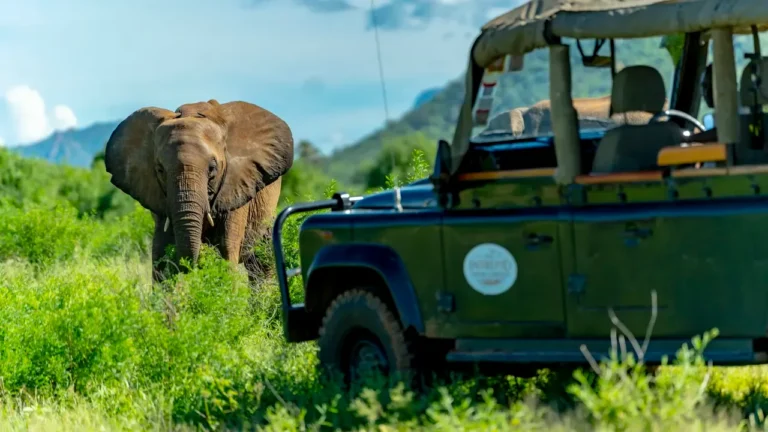
Dawn is for cool air, tracks and active predators. As the sun rises, we read elephant routes, river access and shade. Late afternoon restores colour to the landscape and brings animals back towards water. A private vehicle allows us to stay with behaviour: a herd deciding whether to cross, giraffe testing the wind, or a leopard whose body language tells us it does not want another vehicle closer.
Photography with Kenny
Samburu is one of Kenny’s favourite classrooms because it teaches more than long-lens portraiture. He helps guests use the river as a leading line, protect pale skies from overexposure, position for dust and backlight, and leave room around an elephant family so the photograph carries movement. At eye level, Grevy’s zebra stripes can become abstract; with a wider lens, doum palms and volcanic hills explain where the animal lives. Phone photographers learn the same essentials: light, background, timing and respectful distance.
Walks and specialist activities
Guided walks, bird walks, camel-supported outings, community visits and conservation experiences are more often offered by particular camps or community conservancies than as unrestricted activities inside every reserve. Minimum ages, locations and operating conditions vary. We confirm the precise activity before including it, and we never describe a walk as available simply because it is possible somewhere in the region.
How long to stay
Three nights is a strong minimum for the core Samburu–Buffalo Springs experience. It gives two full days without forcing every reserve into a single long drive. Four nights allow a slower photographic programme, a Shaba day or a community-conservancy experience. Travellers continuing deeper into northern Kenya should consider Samburu a threshold rather than a quick stop: it is where the ecology, people and scale of the north begin to make sense.
Getting there
By road, the usual route runs north from Nairobi through the central highlands, past the Mount Kenya region and Isiolo towards Archer’s Post. Time depends on the starting point, traffic, stops and current road conditions. We treat the journey as a transition through changing altitude and vegetation, with an early departure and a realistic arrival plan.
Scheduled flights may serve airstrips in or near Samburu and Buffalo Springs from Nairobi Wilson, with routings and frequencies changing by season and operator. Baggage limits are stricter than on large aircraft. A fly-in itinerary saves time, but it must still account for the distance between the chosen airstrip, camp and reserve gates. We confirm the actual flight and ground plan before describing it as seamless.
Where to stay
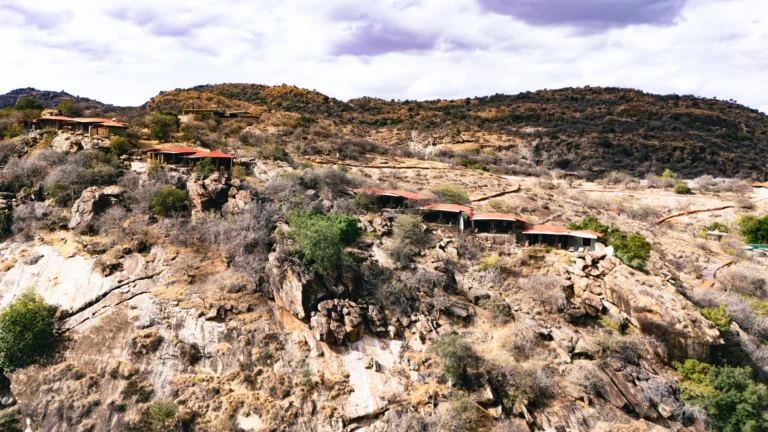
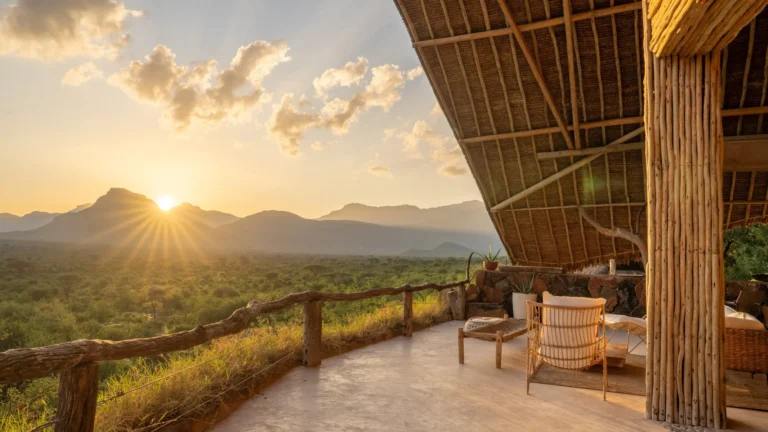
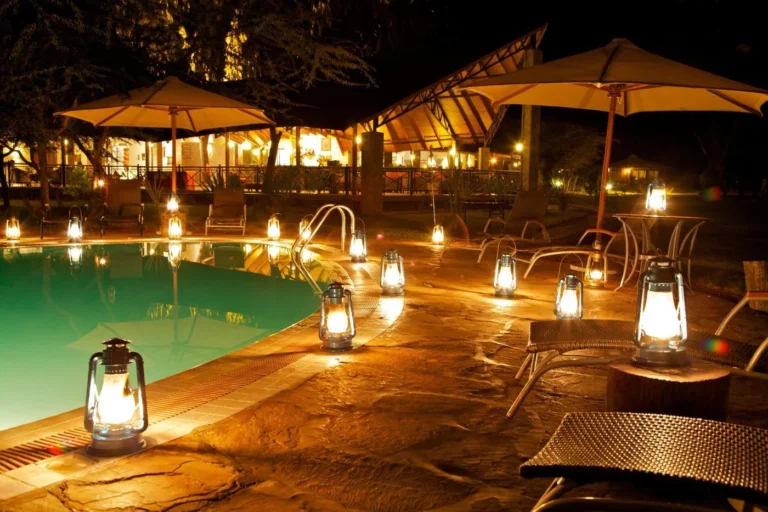
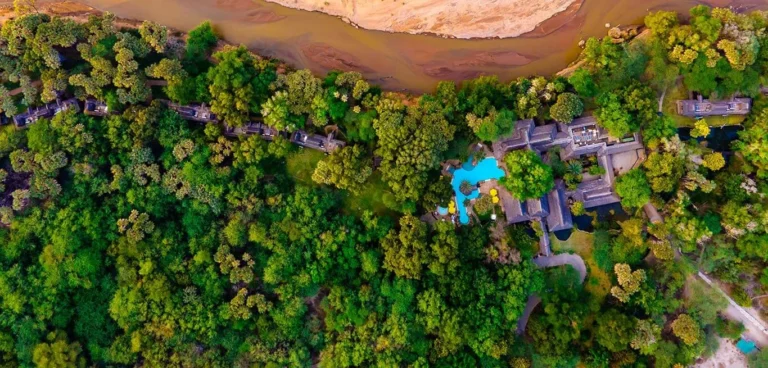
Riverfront camps deliver wildlife atmosphere and quick access to the Ewaso Nyiro, but location matters: two properties carrying a Samburu label may sit in different reserves or community conservancies. Larger lodges can suit families and groups; intimate tented camps offer a quieter rhythm; private conservancies may add walking, cultural or night experiences unavailable in the national reserves.
We choose by guiding quality, vehicle policy, exact reserve access, room configuration, heat management and value. A beautiful room on the wrong side of a long daily transfer is not automatically the better safari.
Best time to visit
The region is open year-round, and every season changes the story. Drier periods concentrate dependence on permanent water and can simplify wildlife finding, while dust and heat become stronger. Rain transforms the plains quickly, disperses animals, brings dramatic skies and improves colour for photography. Heavy local or upstream rain can alter river crossings and tracks. The Ewaso’s condition should never be predicted from the Nairobi weather alone.
June to October and the drier months early in the year are popular, but there is no single month that guarantees wildlife, cool temperatures and an empty reserve. We plan according to photography, family dates, birding, heat tolerance and the rest of the Kenya route.
Combining Samburu well
Mount Kenya and the central highlands
The road geography makes Samburu a natural continuation from Nanyuki or the northern side of Mount Kenya. A mountain or forest stay softens the transition into the hotter lowlands. Read our Mount Kenya guide.
Maasai Mara
The contrast is powerful: dry northern river country followed by the Mara’s grassland and predator-rich plains. Air connections may be direct on some operating schedules or require routing through Nairobi Wilson. We verify the date rather than promise a nonstop flight. Explore the Maasai Mara guide.
Amboseli
Both are celebrated for elephant, yet the photographs and ecology are entirely different: Ewaso riverbanks and doum palms in the north, wetlands and Kilimanjaro horizons in the south. See our Amboseli guide.
Responsible travel in Samburu
- Give elephant families clear access to water and never block a river crossing.
- Keep vehicles on authorised tracks and avoid crowding predators or rare wildlife.
- Ask who benefits from a cultural or conservancy experience and obtain consent before portraits.
- Carry refillable water where safe and minimise single-use plastic in a water-stressed region.
- Treat dry seasons honestly: wildlife, livestock and communities are sharing limited resources.
Samburu safari FAQ
Are Samburu, Buffalo Springs and Shaba one park?
No. They are separate reserves in the same Ewaso Nyiro ecosystem, managed across Samburu and Isiolo counties. Gate tickets, crossings and operating arrangements should be checked for the actual itinerary.
Which reserve is best?
Samburu is the strongest first base, Buffalo Springs adds open southern-bank country, and Shaba offers volcanic scenery and a quieter pace. The best choice depends on water, season, accommodation and time.
Will we see the Special Five?
The region is an excellent place for those species, but no ethical guide guarantees all five. We focus on habitat and behaviour, not a rushed scorecard.
Is Samburu suitable for children?
Yes, with a private pace, suitable accommodation and careful heat management. Some walks and specialist activities have age restrictions.
Can Kenny teach us wildlife photography?
Yes. Photography guidance can be built into an ordinary private safari or made the main purpose of the journey, from camera settings and vehicle position to patient observation and ethical fieldcraft.
Plan a private northern Kenya safari
Tell us your dates, group size, comfort level and whether your priority is elephant behaviour, photography, birding, family travel or a longer northern expedition. We will match the right reserve, camp and number of nights to the season instead of selling every traveller the same “Samburu package”.
Start planning with Wilderness Alternative Expedition
Wildlife sightings, river flow, reserve crossings, specialist activities and flight routings depend on natural conditions, current regulations and confirmed operations.