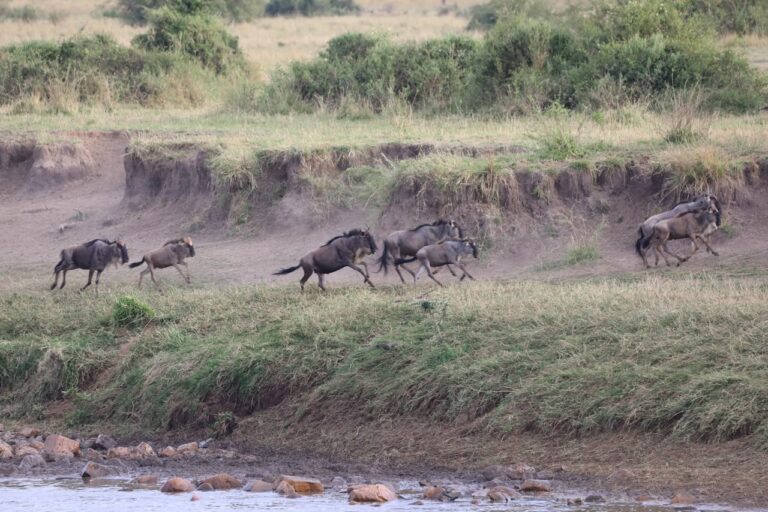

The Great Migration is not a circle drawn on a map. It is a daily response to water, grass and weather by roughly 1.6 million wildebeest accompanied by zebra, gazelle and the predators and scavengers that live around them. Any guide who speaks about it with certainty is simplifying a wild system.
A useful calendar, with honest limits
December to March: the southern plains
Short-grass country around Ndutu and southern Serengeti becomes the centre of movement after rain. Calving is usually most concentrated from late January through February. Cheetah, lion and hyena follow the abundance, but exact herd position shifts across the greater ecosystem.
April to June: moving west and north
As the southern plains dry, long columns begin moving through central Serengeti towards the Western Corridor. May is often associated with rutting. The Grumeti River becomes part of the story from roughly May into July, though crossings may be dispersed and much less predictable than advertising suggests.
July to October: northern Serengeti and the Mara River
Herds spread through Kogatende, Wogakuria and Lamai and may cross the Mara River between Tanzania and Kenya several times. Some days bring enormous crossings; others bring no crossing at all. A good northern stay allows at least four nights and explores resident wildlife rather than waiting at the river from dawn to dark.
October to December: the return south
Short rains encourage new growth and the herds begin moving through eastern and central Serengeti towards the south. This return can be fast, fragmented and photographically beautiful, with storm light and fewer vehicles.
What we will and will not promise
We will use recent field reports, lodge locations and the experience of guides on the ground to improve your chances. We will not promise a river crossing, calving on a specific day or a private view of an unpredictable event. We will never support crowding, blocking a herd’s approach or pressuring wildlife for a photograph.
The better migration safari
Choose a region that is rewarding even when the herd is elsewhere. Stay long enough for weather and movement to change. If budget permits, use a private vehicle so the day can follow your interests. Combine two complementary regions only when the transfer adds ecological meaning rather than collecting names.
Mobile camps such as &Beyond Serengeti Under Canvas are designed to shift with the broader seasonal movement. Permanent camps such as Sayari, Dunia, Namiri Plains and lodges in Grumeti provide a strong sense of place and resident wildlife outside migration weeks. The best choice depends on how much uncertainty you enjoy and what level of comfort matters after a long day.
There is more to migration than crossings
Listen to the sound of thousands of animals grazing at night. Watch a newborn calf negotiate its first hour. Notice vultures gathering over a distant line of trees or zebra testing the edge of a river. These are not consolation prizes. They are the migration itself.
For regional detail, continue to the full Serengeti guide or read our advice on photographing the Serengeti.
Plan for a movement, not a date
The Great Migration is a continuous search for grass and water by wildebeest, zebra and other grazers across the Serengeti–Mara ecosystem. Rainfall—not a calendar—determines the detail. The familiar monthly map is useful for choosing a region, but it cannot tell a herd where to be on one traveller’s Tuesday.
The broad seasonal pattern
- December to March: southern Serengeti and Ndutu often hold the herds on short-grass plains, with calving building in the heart of the green season.
- April to June: herds may spread through central and western country as the long rains and drying pattern develop.
- July to October: many animals use the north and the Mara River area, sometimes crossing more than once.
- November: short rains can begin pulling movement south and east, often in dispersed columns.
These are planning bands, not guarantees. Local rain can alter the route by weeks.
River crossings are the least predictable moments
At both the Grumeti and Mara rivers, animals may gather for hours or days and then move elsewhere. A crossing can be obscured, far away or crowded with vehicles. Ethical guiding means keeping access open, respecting instructions and never forcing a position. We sell the chance to be in the right ecosystem—not a guaranteed spectacle.
How to improve your odds
Stay at least four nights in the priority region, choose a camp with honest access and use a private vehicle if waiting matters. Pairing two complementary Serengeti sectors is often stronger than chasing one prediction. For example, north plus central in August protects the resident wildlife experience; south plus central in February adds habitat variety.
Mobile camp or permanent lodge?
Mobile camps follow a broad seasonal strategy and can position well for herds. Permanent lodges provide more infrastructure and strong resident safari. Weather can still move animals away from either. The best choice depends on comfort, budget, number of nights and tolerance for canvas-camp life.
What photographers should know
Migration photography requires patience, dust protection, a private vehicle where possible and a willingness to stay with ordinary behaviour. The most memorable frames are not always river drama: a line of animals under storm light, a newborn calf, a predator watching or a landscape showing the scale of movement.
Choose the region
Read our guides to Ndutu and the southern plains, the Western Corridor and Grumeti, and the northern Serengeti. Then tell us the dates, pace and experience that matter; we will tell you what is realistic.