
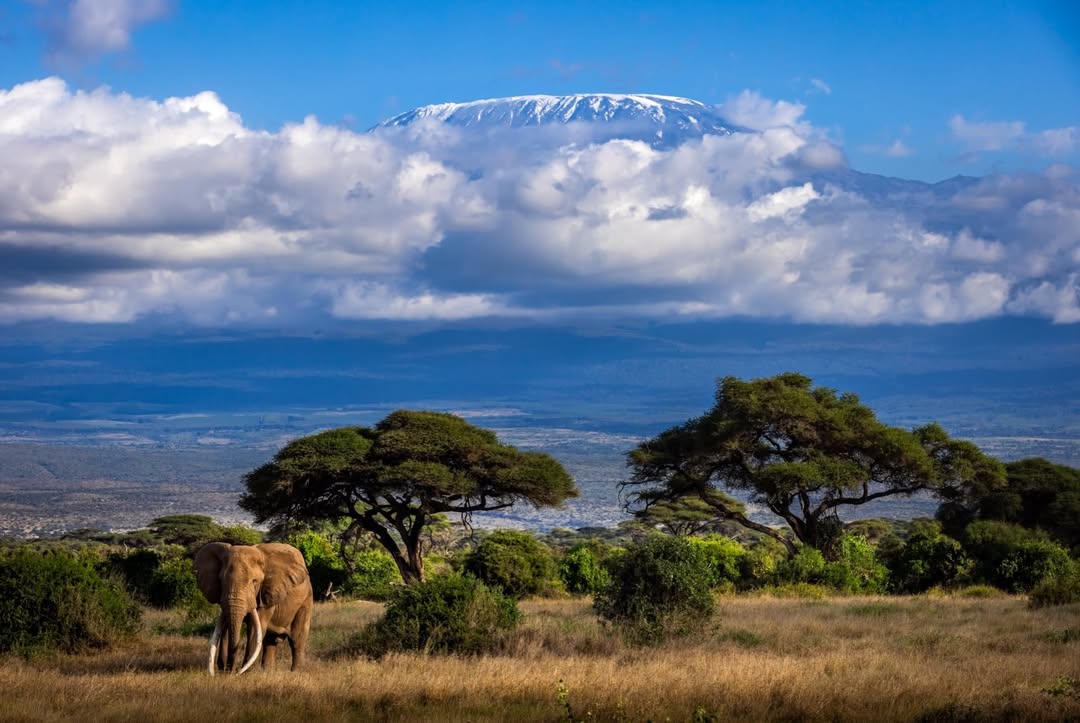
Amboseli field guide
Wildlife & Elephants of Amboseli
Understand Amboseli’s elephant families, bulls, wetlands, communication and wider wildlife through the eyes of an experienced safari guide.
Begin with individuals
The value of an Amboseli elephant sighting lies less in how close the animal comes than in how much time you give it. Stay, watch and the herd becomes a family.
Elephants with histories
Amboseli is one of the world’s great places to move beyond “an elephant sighting” and begin recognising elephant society.
Long-term research has followed the lives of Amboseli elephants since 1972, with continuous individual-based field records developing from 1976. Researchers and field teams have documented births, deaths, associations, movements and responses to drought over generations. The result is not a wildlife census frozen in time, but a remarkable social history.
For the traveller, that history changes the encounter. A guide does not only point out a herd; they begin with its shape. The smallest calves are held towards the centre. Mothers, sisters and aunts form the stable family unit. Older females carry experience of routes, water and difficult seasons. Ear tears, tusk shape, body size and behaviour can distinguish individuals when observation is close and patient.
Amboseli’s open ground makes this social life unusually legible. You can watch a family gather before crossing a road, see a matriarch test the wind, or notice how quickly adults close around a calf when uncertain. These are not performances. They are decisions being made in real time.
Inside the family
Matriarchs, calves and growing up
The matriarch is generally an older, experienced female whose judgement helps guide the family. Leadership is not simply a matter of walking first. It can be expressed in when to move, when to pause, which direction to take and how to respond to threat. Knowledge accumulated across dry years may be particularly important when water and forage are difficult to find.
Calves enter a protective world of trunks and legs. In their early months they depend entirely on milk and close contact, sleeping more often and struggling with a trunk that seems to have too many possibilities. They imitate feeding, splash in shallow water and test social boundaries through play. Other females may assist and guard them.
Adolescents are more experimental. Young males spar, lean, shove and stage mock charges; young females learn the social work of the family. An apparent burst of aggression may be play, excitement or uncertainty rather than a true charge. Your guide reads the whole body—head position, ear posture, tail, trunk and the response of nearby elephants—rather than interpreting one gesture in isolation.
Families communicate with touch, scent, posture, trumpet and low-frequency calls. Some rumbles travel over considerable distance. Inside a silent vehicle you may hear a deep vocalisation, but you may also notice communication through coordinated movement: one animal stops and others respond before the visitor has heard anything.
When a family approaches, the guide should leave its route open, hold position and let the elephants choose the distance. Blocking a crossing, repeatedly starting the engine or surrounding animals for photographs changes their behaviour and diminishes the sighting.
The lives of bulls
Power without the stereotype
Mature bulls are not permanent loners. Their lives include loose associations, learning, competition and periods of intense reproductive activity.
Leaving the family
Males gradually spend more time away from their natal family as they mature. Contact with older bulls matters; it provides social experience that younger animals cannot gain only among their peers.
Range and companionship
Large bulls may feed alone, walk with other males or join mixed groups temporarily. Amboseli’s marshes can offer superb opportunities to watch them feed quietly at close but respectful range.
Read the signals
During musth, a bull may show temporal-gland secretion, urine dribbling and a more purposeful gait. An experienced guide gives such an animal space and never treats its focus as a challenge.

Water shapes the day
From dry country to swamp
Amboseli elephants move through a landscape whose essential water often arrives underground from Kilimanjaro’s volcanic slopes. During drier periods the permanent wetlands become critical feeding and cooling areas. Families may cross open country in the morning and enter the green as temperatures rise.
In the swamp, watch feeding technique. Elephants pull sedge and grass, shake or wash roots and work through vegetation with steady efficiency. Mud darkens their skin. Calves disappear between adults. Egrets lift and settle around their feet while buffalo and hippo occupy neighbouring channels.
These movements extend beyond the park. Elephants use community land, dispersal areas and corridors linking the wider Tsavo–Chyulu–Kilimanjaro landscape. Their future depends on keeping that mobility possible, which connects an elephant sighting directly to the work described in our guide to community and conservation in Amboseli.
Beyond elephants
The company they keep
A complete Amboseli drive reads the whole habitat, not only its largest animal.
Grazers and predators
Zebra, wildebeest, buffalo, giraffe and gazelles occupy the grasslands and woodland margins. Lion, cheetah, spotted hyena and jackal are present, with sightings shaped by season, cover and movement.
Hippo, buffalo and birds
Hippo channels thread the marshes; buffalo wallow and waterbirds crowd the feeding edges. Herons, egrets, pelicans, kingfishers and jacanas reward time spent scanning the green.
Read the reactions
Impala staring, zebra bunching, oxpeckers lifting or elephants raising their trunks may reveal a change before the cause is visible. Field interpretation turns scattered sightings into a connected story.
Continue exploring
Build a complete understanding of Amboseli
Plan with a Kenya specialist
Turn field knowledge into a better safari
Tell us what matters to you and we will shape the pace, guiding, accommodation and route around your dates and travelling party.