

Amboseli field guide
Photography in Amboseli
A practical Amboseli photography guide to elephants, Kilimanjaro, dust, wetlands, light, lenses, vehicle positioning and patient fieldcraft.
Begin with the story
A long lens can make the mountain enormous. A wide frame can make the elephant seem small. Decide what the picture is about before deciding what equipment to lift.
Photograph the relationship
Amboseli is not simply a place to photograph elephants and Kilimanjaro. It is a place to photograph why elephants and Kilimanjaro belong in the same visual story.
The strongest frames describe habitat: an elephant family crossing the open basin, a bull dark with marsh water, cattle and dust beyond a conservancy boundary, cloud gathering around the mountain or egrets lifting from feeding feet. Close portraits are possible, but environmental compositions are what make Amboseli unmistakable.
Start by watching direction. Elephants are often moving between dry feeding country and wetland. A guide who understands their likely line of travel can choose a legal road position, switch off and allow the scene to assemble. A vehicle that continually reverses, circles or blocks the route may get closer, but it usually produces more stress and a less natural picture.
Patience is therefore an equipment choice. It requires enough time, control of your vehicle and a guide comfortable ignoring the pressure to chase every radio call.
Lens thinking
Wide, standard and telephoto
Place the animal in Amboseli
A wide frame shows scale, negative space, sky and habitat. It works best when an elephant is reasonably near, the foreground is clean and the mountain or wetland adds meaning rather than clutter.
The flexible safari choice
A mid-range zoom moves quickly between family behaviour and environmental composition. For ordinary guests carrying one camera, it is often the most useful range in the vehicle.
Compression and behaviour
Longer focal lengths isolate detail, preserve respectful distance and visually enlarge Kilimanjaro behind a subject. They also magnify heat haze, vibration and poor background choices.
Serious photographers often carry one body with a standard zoom and another with a telephoto. This reduces lens changes in dust and prevents a close behavioural moment from being lost while changing equipment.
Work with the day
Light gives Amboseli its voice
Before sunrise, exposures are slower and colour is cool. Silhouettes can simplify a busy herd, while a first clear line of light may catch only the mountain summit or the rim of an elephant’s ear. Use support, raise ISO without fear and watch shutter speed when animals are walking.
Early morning offers the best usual chance of a clean Kilimanjaro view. Do not wait for the animal to stand directly beneath the summit; lateral space can create a more elegant composition. A long lens compresses the gap. A wider lens explains it.
By late morning, harsh light is not necessarily useless. In the marsh it can reveal vivid colour, feeding technique, reflections and birds around elephants. Overcast weather softens skin texture and reduces the extreme contrast between dark animals and bright sky.
Late afternoon gives warmth and direction. Backlit dust turns movement visible, but exposure must protect highlights and preserve a readable animal shape. Position so the dust falls into the light rather than between the camera and a flat background.
After rain, colour intensifies and dark cloud creates separation from pale tusks or grey skin. Wet-season conditions demand a rain cover or simple protective cloth, dry storage and discipline about changing lenses.

Background is a decision
Look beyond the subject
An elephant can be magnificent and the photograph still fail because another vehicle cuts through its legs, a bright sky pulls the eye or the horizon intersects the head. Before releasing the shutter, scan the edges. Ask whether moving a metre along the legal road—or simply waiting two steps—will clean the frame.
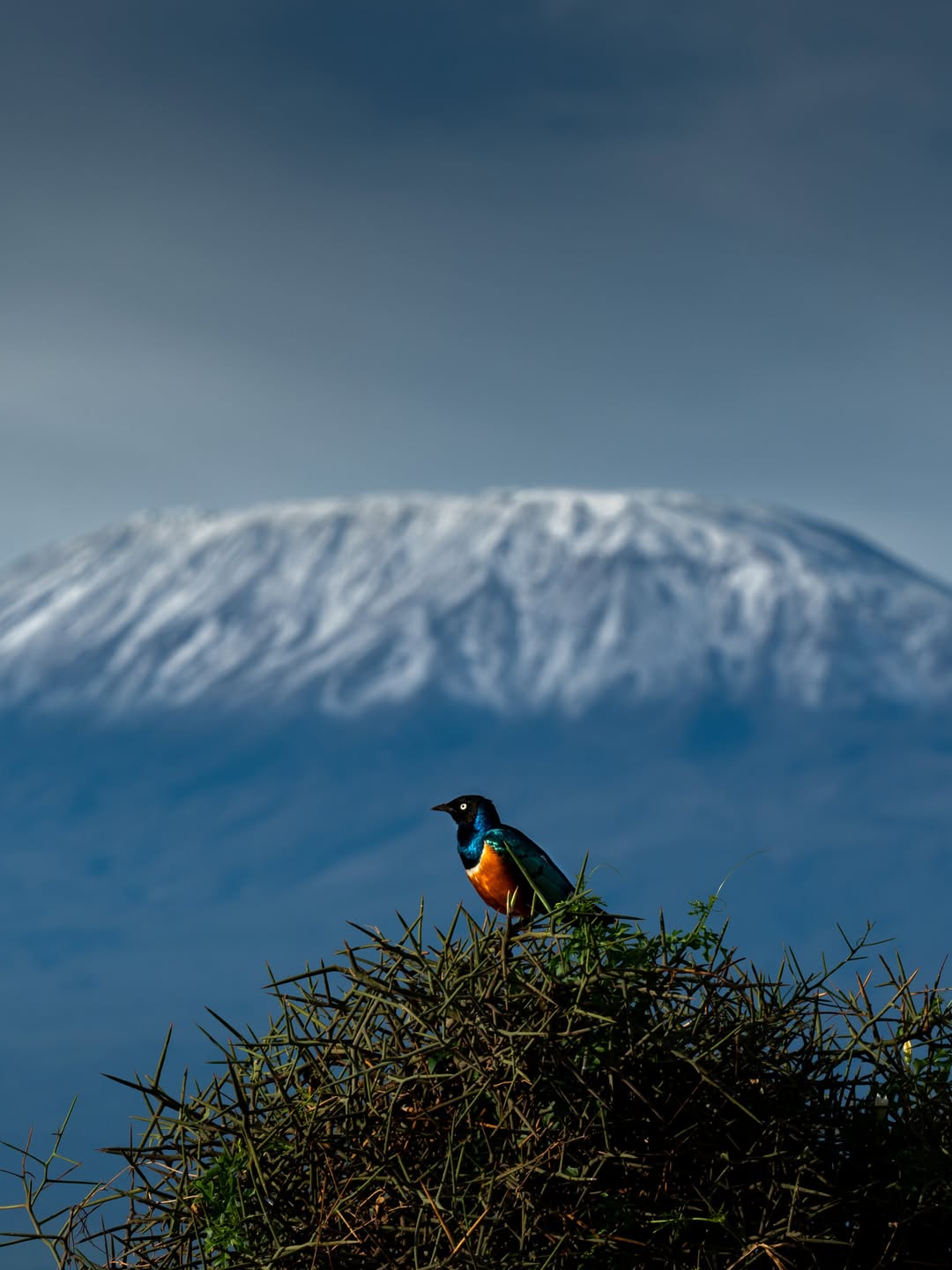
For Kilimanjaro images, the subject, mountain and light all need to align. That makes them opportunities rather than entitlements. Photograph what the animal is doing while waiting. Feeding, greeting, touching and calf protection will outlast a generic line-up beneath a mountain.
Wetlands need careful exposure because water and green vegetation can be bright against a dark elephant. Birds add scale and movement. A slow shutter may turn a flock into atmosphere, while a fast shutter freezes drops, dust or play.
Silhouettes work when shapes separate clearly. A family compressed into one dark mass is less readable than individuals with visible trunk, tusk and leg lines.
Learn in the field with Kenny
Photography taught from the guide’s seat
Wilderness Alternative founder and guide Kenny is also a committed wildlife photographer. In Amboseli, he brings those two ways of seeing together.
Kenny teaches at the level of the guest, whether that means making a first confident photograph on a phone, moving beyond automatic camera settings or refining an experienced photographer’s approach to light and animal behaviour. The teaching happens in the sighting, not as a lecture separate from the safari.
He can help you understand shutter speed when elephants are walking, exposure when a dark subject stands against bright sky, focal-length choices for Kilimanjaro, clean backgrounds, silhouettes, dust and backlight. Just as importantly, he explains when to wait, when to reposition and when the animal’s welfare requires the vehicle to give ground.
The purpose is not to return with hundreds of identical frames. It is to learn how a guide-photographer reads direction, light, behaviour and habitat before lifting the camera—and to take that way of seeing home with you.
Tell us what equipment you use and what you want to learn before the safari. Kenny can shape the drive around phone photography, beginner camera skills, wildlife behaviour, environmental composition or more serious photographic objectives.
Vehicle craft
Why private use changes the result
Photography needs control over time, seat position and priorities. A private vehicle buys that control.
You can ask for windows to be opened, remain with a single subject, return to a promising area, choose birds over big cats and delay breakfast when the light is working. Beanbags stabilise cameras on window frames; open-sided or pop-top vehicles require different support and awareness of other guests’ sightlines.
Discuss your equipment and objectives before the first drive. A guide cannot position for a wide environmental frame if they assume you carry only a long lens. Equally, the photographer should understand park rules: remain on designated roads, keep a respectful distance, do not pressure animals and never ask a guide to break regulations for an image.
For non-specialists, the same principles apply with less equipment. Clean the phone lens, lock focus, reduce exposure for bright sky and make short video clips rather than filming every minute. Then put the device down. The sighting is the reason for the photograph—not the other way around.
Continue exploring
Build a complete understanding of Amboseli
Plan with a Kenya specialist
Turn field knowledge into a better safari
Tell us what matters to you and we will shape the pace, guiding, accommodation and route around your dates and travelling party.