
The Great Wildebeest Migration
A million moving animals, one immense ecosystem and no rehearsed performance.
First comes a sound like distant rain. Then the horizon begins to move. Wildebeest pour over a rise in dusty columns, zebra thread between them and calves call for their mothers amid the low grunts of the herd. The Great Migration is often described as a spectacle, but it is more profound than a single dramatic crossing. It is the annual pulse of the Serengeti–Mara ecosystem: birth, hunger, rain, grass, pursuit and survival unfolding across northern Tanzania and southern Kenya.

More than a million wildebeest move with hundreds of thousands of zebra and gazelles through this connected landscape. Their circuit can cover roughly a thousand kilometres, with individual animals travelling farther as they search, divert and return. The herds do not follow an international border or a tourist calendar. They respond to the things that matter to a grazer: rain, fresh growth, mineral-rich forage and dependable water.
This movement also carries life through the ecosystem. Migrants consume enormous quantities of grass, return nutrients through dung and carcasses, open grazing for smaller herbivores and feed a vast community of predators and scavengers. Lions, cheetahs, leopards, hyenas and crocodiles receive the most attention, but vultures, jackals, insects and soil organisms are part of the same cycle. The migration is not a race to a finish line. It is an ecological relationship renewed each year.
Why the herds keep moving
Rain starts the conversation; grass and water decide the route.
Wildebeest are exceptionally well adapted to finding short, nutritious grasses. When rain reaches dry ground, new shoots appear and the herds begin to orient toward that fresh growth. They may be influenced by local storms, the smell and sound of rain, distant lightning and knowledge carried through generations, but no single cue explains every turn.
The different grazers use the same landscape in complementary ways. Zebra can tackle taller, coarser grass. Wildebeest follow the shorter regrowth, while Thomson’s gazelles and other smaller grazers select finer leaves and herbs closer to the ground. This succession spreads pressure across the plains and allows different species to travel together without eating exactly the same meal.
Water becomes increasingly important in the dry season. In the northern part of the ecosystem, the Mara River is a vital permanent water source—and a dangerous obstacle. Its importance is one reason the migration cannot be understood through photographs of crossings alone: the river supports life before, during and after those explosive moments.
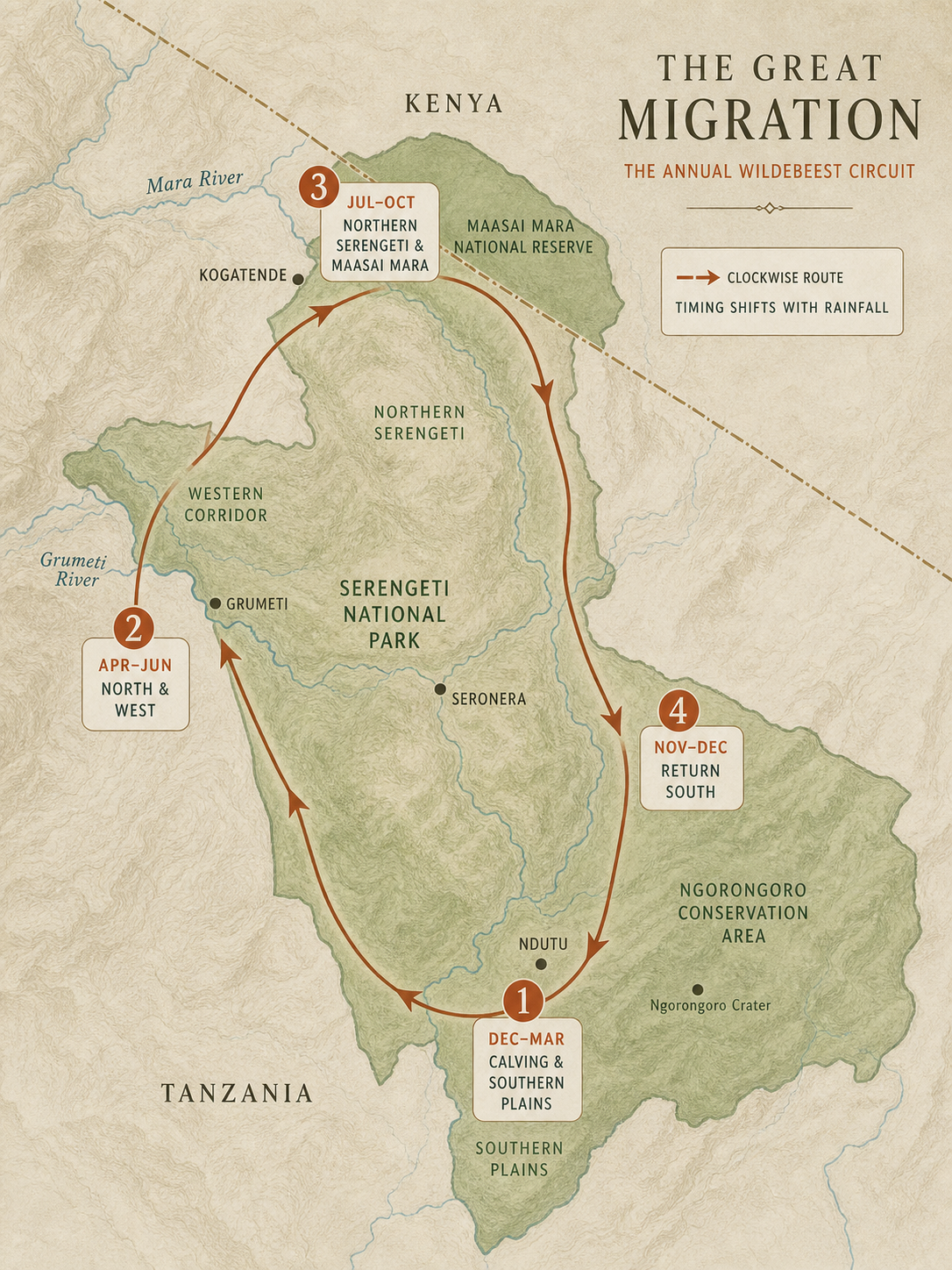
The broad annual circuit. Exact timing and herd position change with rainfall and local conditions.
How the year generally unfolds
Four seasons in one continuous story.
Calving on the southern plains
Short rains usually renew the mineral-rich grass around Ndutu, the southern Serengeti and the plains bordering the Ngorongoro Conservation Area. Herds spread across this open country to feed, and the main calving pulse typically gathers pace in February. Hundreds of thousands of calves may be born within a few concentrated weeks.
Birth brings abundance and vulnerability. Newborns can stand within minutes, yet lions, cheetahs, hyenas and jackals patrol the plains. This is not the river-crossing season; it is a more intimate chapter of mothers, calves, hunting and fast-changing weather.
North through the Serengeti
As the southern plains begin to dry, scattered herds collect into longer columns and move through the central Serengeti. Some turn toward the Western Corridor and the Grumeti system; others take more easterly paths. Rains can make tracks difficult while the landscape becomes lush and dramatic.
By late May and June, movement often gains urgency. Courtship and rutting behaviour may be visible, and the scale of the columns can be remarkable. Grumeti crossings occur, but they differ from the Mara River scenes and are equally impossible to schedule precisely.
Northern Serengeti and Greater Mara
As the dry season strengthens, many herds reach the northern Serengeti and may cross into Kenya’s Greater Mara. They can spread widely across the Maasai Mara National Reserve, Mara Triangle and adjoining areas, sometimes travelling back and forth across the Mara River or smaller channels.
This is the period most associated with Kenya’s migration season and the busiest time for camps. Yet even now, being in the Mara does not guarantee a crossing. A patient safari is designed around the whole landscape—predators, elephants, resident plains game, changing light and the possibility of migration action.
The long return south
When storms begin to revive Tanzania’s northern and eastern grasslands, herds gradually turn south. The return is rarely one neat line. Groups may move through Kogatende, Lamai, Lobo and the central Serengeti at different speeds, responding to patches of rain and green growth.
By the end of the year, many animals are approaching the southern plains again. Pregnant females arrive carrying the next generation, and the circular story begins anew.

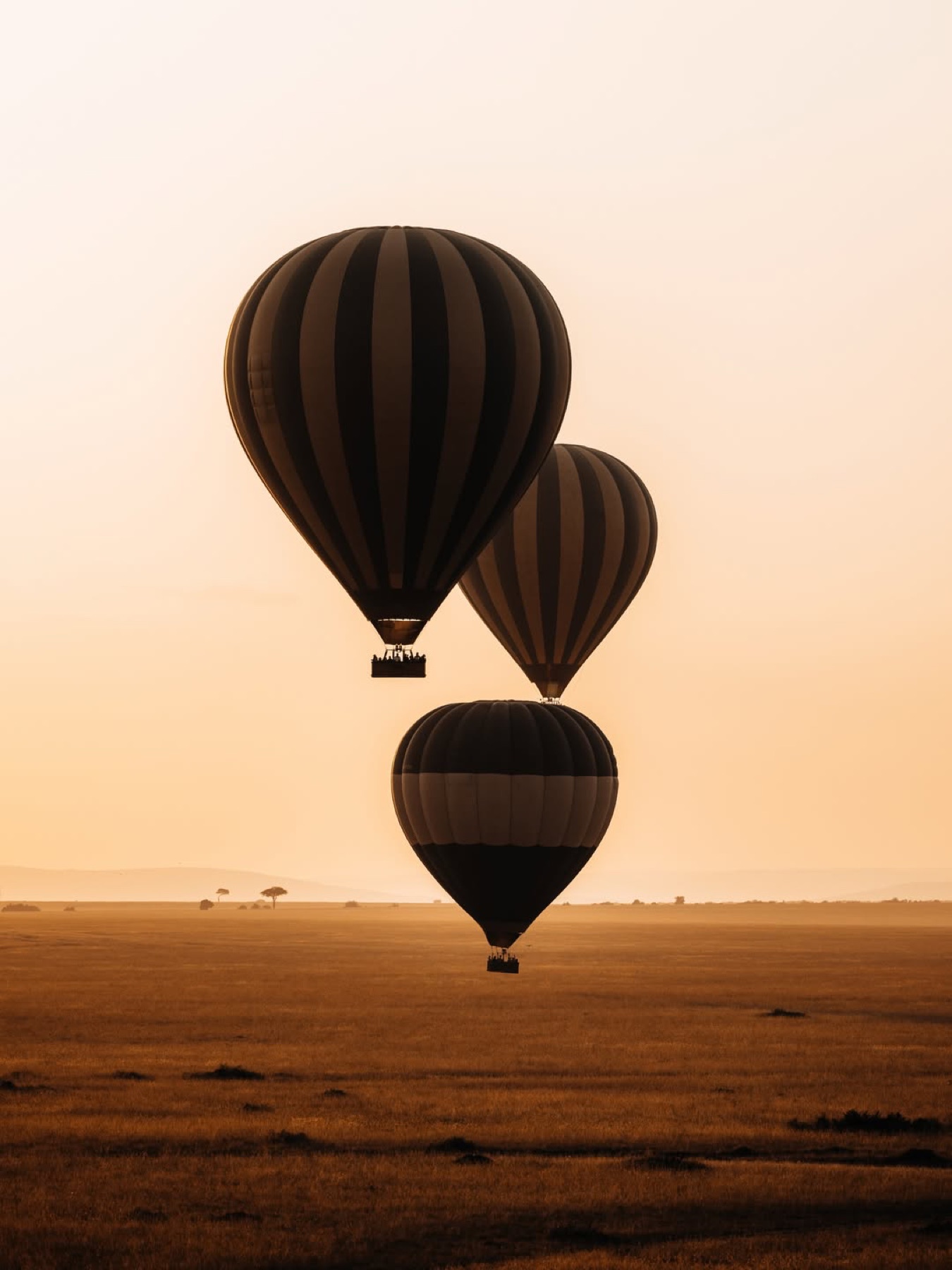
The truth about river crossings
Extraordinary when they happen. Impossible to command.
A crossing can begin with thousands of animals waiting on a bank. They edge forward, retreat, bunch together and sometimes disappear without entering the water. Hours later, pressure within the herd may trigger a sudden plunge—or nothing may happen until the following day.
River level, bank shape, herd density, crocodiles, predators, noise and vehicle positioning all influence events. Herds can cross at an unexpected point, cross before dawn, move when guests are elsewhere or return over the same river later. A truthful operator never guarantees a crossing and never turns a safari into a high-speed chase from one rumour to another.
The right guide reads behaviour, keeps a legal and ethical distance, protects the animals’ approach to the water and positions with patience. If a crossing unfolds, you witness it without blocking the route. If it does not, the day should still contain the Mara’s deeper rewards.
Plan a migration safari that remains exceptional even if no crossing occurs.
Give the herds time
Two rushed nights create pressure to manufacture a result. Four or more nights give your guide room to follow fresh field information, explore different river sectors and wait when animal behaviour asks for patience.
Stay in the right ecosystem
Your camp should be chosen with likely seasonal movement, daily driving distances and access rules in mind. A reserve–conservancy combination can add contrast, but only when it improves the experience rather than consuming it with transfers.
Build around the whole Mara
Use a private vehicle, begin early and remain flexible. The strongest journey values lions at first light, elephant families, riverine leopards, hyena clans, birds and open landscapes as highly as the possibility of migrant herds.
Migration without the hype
Resident wildlife is not the consolation prize—and the animals are never a stage show.
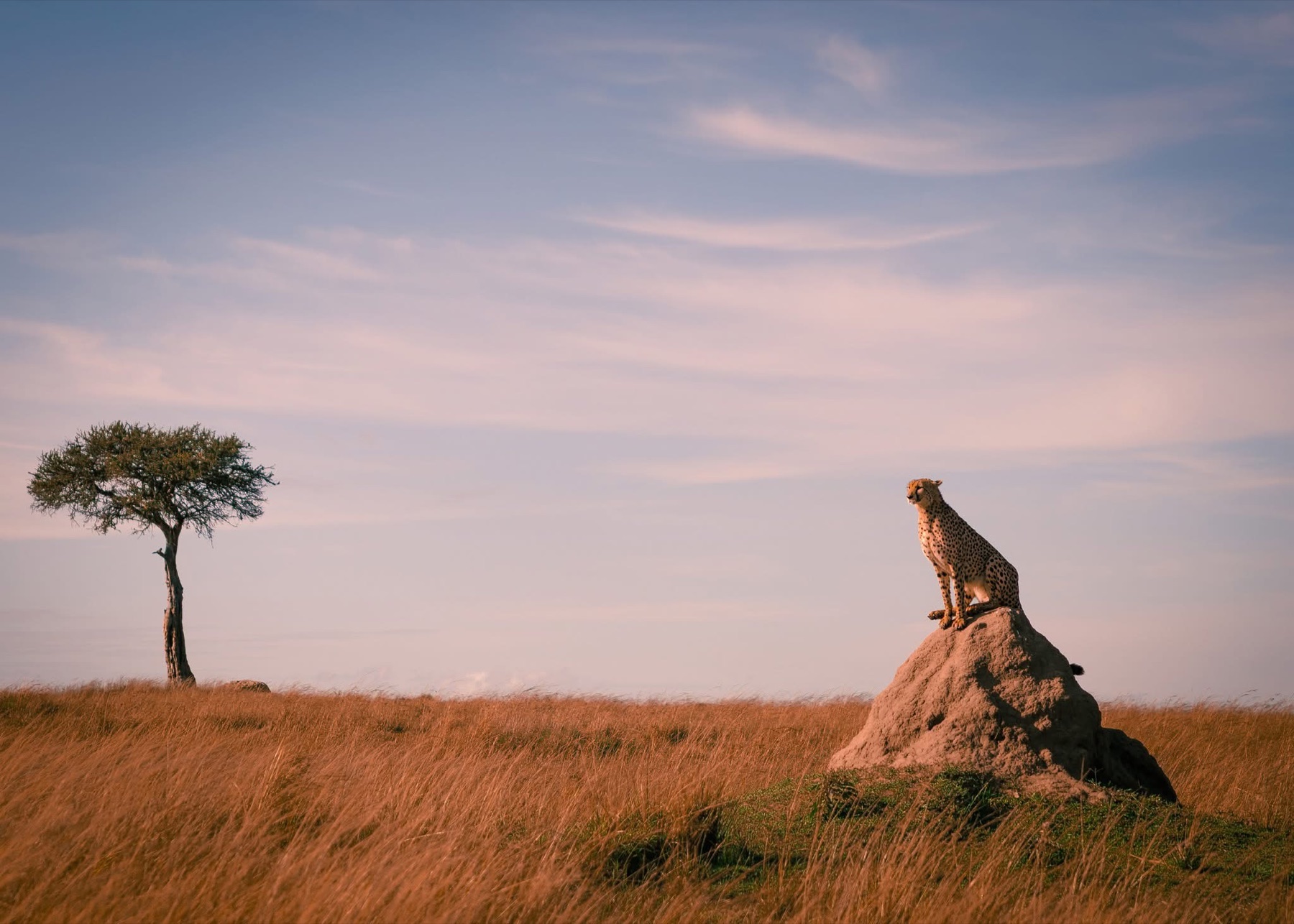
The Mara’s lions, cheetahs, leopards, elephants, hyenas, giraffes and plains game do not vanish when the migrant herds leave. Green-season light, flowering grasslands, newborn resident animals and quieter roads can be deeply rewarding. The best month depends on the experience you want, not on one dramatic image repeated across the internet.
Responsible viewing protects the very behaviour guests travel to see. We avoid crowding, blocking, off-road damage where it is prohibited and any pressure that forces animals to change direction. During a crossing, restraint matters: access to the bank must remain open and the guide’s first responsibility is to the safety of wildlife and guests.
Plan with a Kenyan safari team
Let the landscape decide the safari.
Tell us when you hope to travel, who is travelling and what matters most. We will recommend the right Mara area, camp style and pace—without forcing a standard package.