
Why stay here
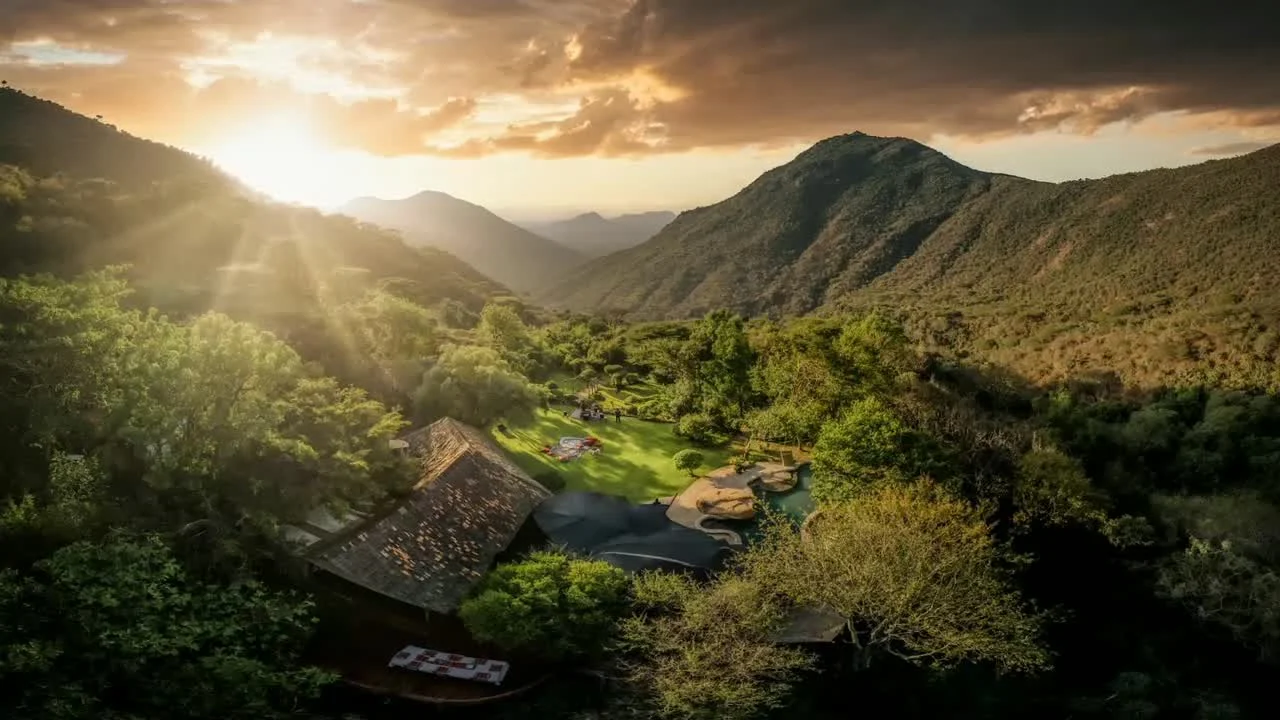
Desert Rose occupies one of the most improbable settings in Northern Kenya: high on Mount Nyiru, where springs and forest soften a landscape otherwise defined by rock, heat and enormous distances. It is not a conventional safari lodge and should not be chosen simply as somewhere to sleep between two map points. The reason to come is the mountain itself and the rare chance to stop between Samburu country and Lake Turkana without losing the feeling of expedition.
The lodge is particularly valuable on a private overland journey. It breaks a demanding northern route at a place with genuine character, allows guests to walk and recover, and reveals how quickly the ecology changes with altitude. From the dry plains below, the ascent into greener slopes feels like entering another climatic world.
Setting and atmosphere
Mount Nyiru rises west of the South Horr area and south of Lake Turkana. Its upper slopes catch moisture, support forest and feed springs, while the country below returns abruptly to arid valleys and volcanic plains. Views open towards an immense northern horizon, but the experience is quieter and more enclosed than the exposed desert lodges nearer the lake.
Desert Rose has grown from local stone, timber and the contours of the site rather than from a standard hotel plan. Rooms and shared spaces feel handmade and individual. The result is more like a remote mountain home than a formal resort: comfortable, atmospheric and inseparable from its location.
Rooms and lodge life
Accommodation is arranged in individually designed cottages or houses, with natural materials, private washing facilities and views shaped by the slope. Exact room configuration matters for families and private groups, so Wilderness Alternative confirms the current unit, bedding and privacy arrangement before booking rather than relying on a generic room label.
Days begin and end around the lodge, with meals, conversation and time to absorb the altitude change. Water and power are managed in a genuinely remote environment. Guests should expect thoughtful comfort rather than urban-style infrastructure, and should arrive prepared for limited connectivity and the possibility that weather or road conditions alter the rhythm of the day.
Walking and the wider landscape
Guided walks are the natural way to understand Mount Nyiru. The emphasis is not on a checklist of large mammals but on forest, water, birds, plants, views and the relationship between highland resources and the pastoral country below. Routes must reflect current conditions, guest fitness and local guidance.
For photographers, the transition between forested slope and desert basin is often more compelling than a single wildlife sighting. Morning and late-afternoon light can reveal layers of ridges, dry valleys and the distant northern country. A private itinerary gives enough time to wait for that light instead of treating the lodge as a quick overnight stop.
Best for
Choose Desert Rose for experienced safari travellers, couples, private families with older children, photographers and anyone drawn to remote landscapes. It suits guests who value ownership, character and geographic context more than a large spa, constant connectivity or a long resort activity list.
It is less suitable for a first safari built around dense game viewing, for very short holidays, or for travellers uncomfortable with long transfers and contingency. The lodge makes most sense as one chapter in a properly planned Northern Kenya expedition.
Getting there
Access is part of the journey. Depending on the wider route, Desert Rose may be reached by private 4×4 from Samburu, Namunyak or the South Horr corridor, or by a charter arrangement combined with a ground transfer. The final approach, road condition and daylight requirement must be checked for the travel date.
We do not publish a fixed driving time for this sector because rain, road works, river crossings and the chosen starting point can materially change it. Wilderness Alternative plans the vehicle, fuel, communications, lunch, water and conservative arrival margin together. In Northern Kenya, good logistics are not a backstage detail; they are part of the quality of the trip.
What to combine it with
The strongest southern approach links Samburu or Namunyak with Desert Rose before continuing towards Loiyangalani and Lake Turkana. It can also sit within a longer circuit through Marsabit and the Chalbi Desert, although that route needs sufficient days and a vehicle plan designed for the whole expedition.
Travellers should resist trying to combine every northern name in a week. Desert Rose deserves at least enough time for an unhurried afternoon, a night and a guided look at the mountain before the next major movement.
Wilderness Alternative note
We recommend Desert Rose when its position strengthens the route and the guest understands the reality of remote travel. Before confirmation we recheck access, current operations, room allocation and the next leg of the itinerary. That preparation preserves the romance of the journey without pretending that Northern Kenya behaves like a conventional lodge circuit.