
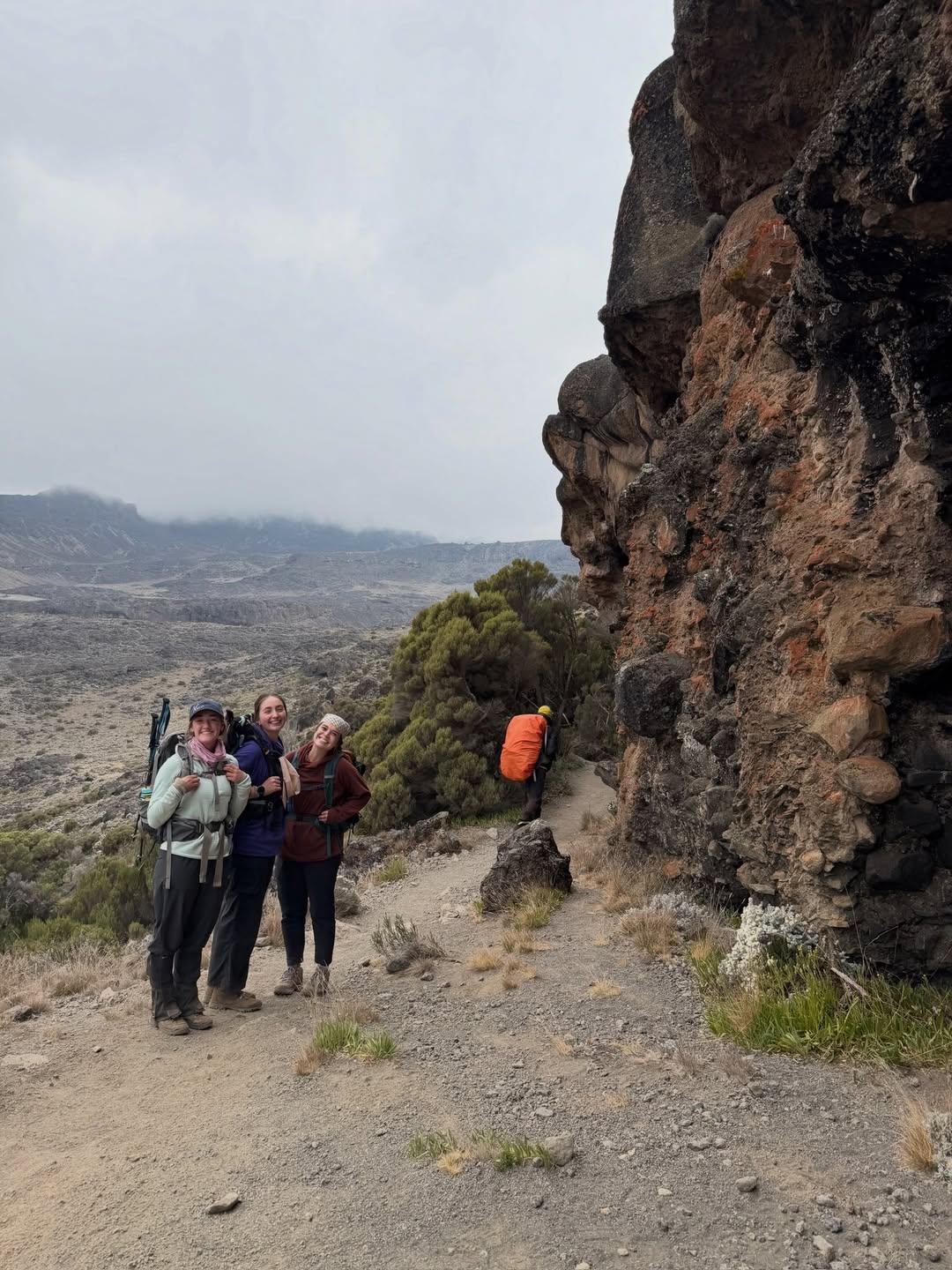
Machame is one of Kilimanjaro’s seven principal ascent routes. It begins at Machame Gate on the humid southern slope. The trail climbs through enclosed montane forest to Machame Camp, crosses heather and moorland to the Shira Plateau, then traverses beneath Kibo through Lava Tower, Barranco, Karanga and Barafu. The route should be judged by how that sequence manages altitude, not by a simplified promise about scenery or summit percentages.
Seven mountain days is the balanced version; six days is possible but removes the Karanga night and useful acclimatisation time. It combines a strong climb-high, sleep-lower pattern with some of the mountain’s most varied scenery. The route is popular. Camps and the Barranco Wall can be busy, especially in the main dry seasons. A short itinerary magnifies both fatigue and altitude pressure.
The route at a glance
- Approach: Machame Gate on the humid southern slope.
- Recommended rhythm: Seven mountain days is the balanced version; six days is possible but removes the Karanga night and useful acclimatisation time.
- Accommodation: Tented camps supported by a guide, cook and porter team.
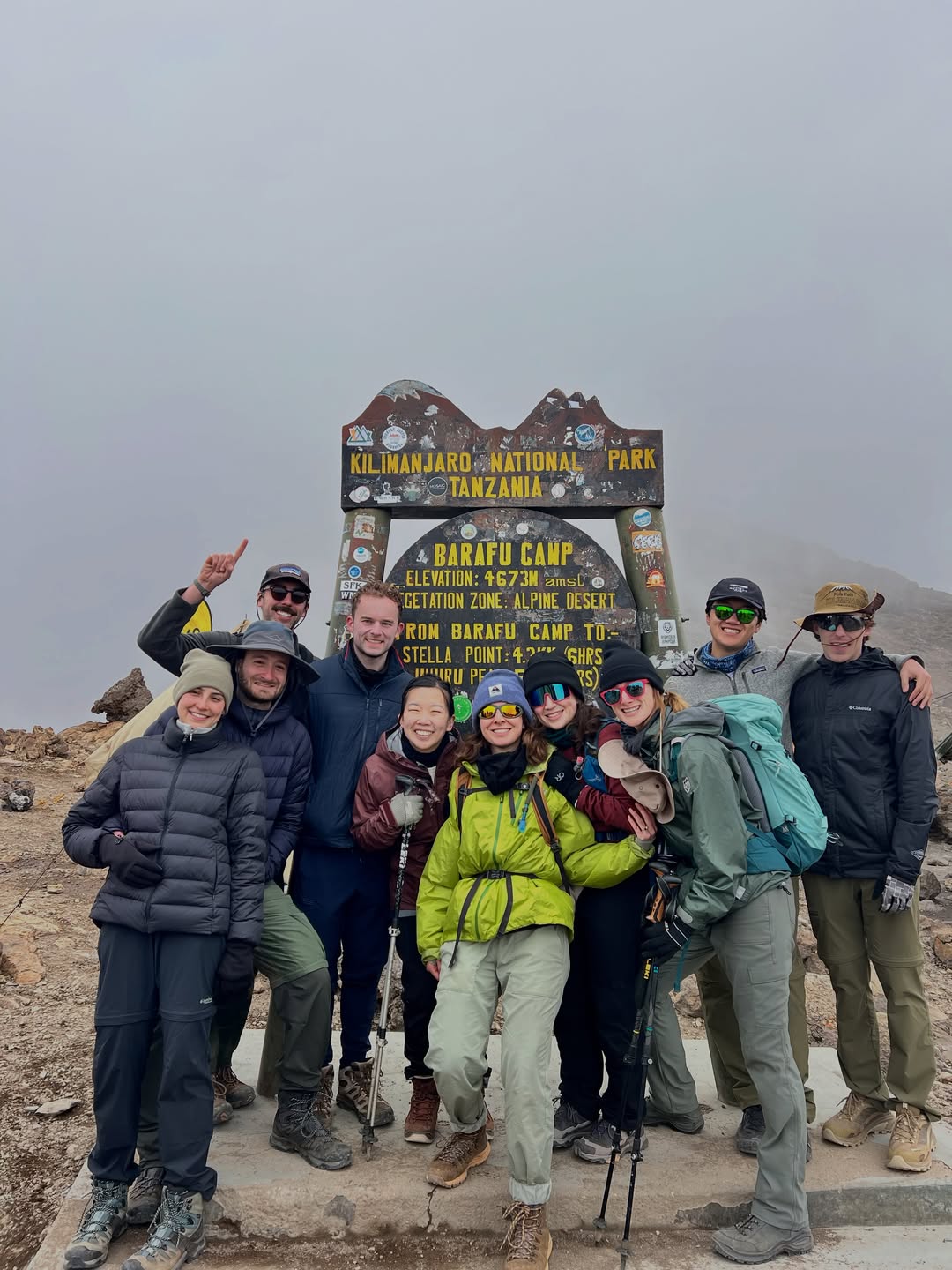
- Summit line: Barafu is the high launch camp. The night ascent reaches Stella Point on the crater rim before continuing to Uhuru Peak, then descends through Barafu and the Mweka corridor.
- Best suited to: first-time high-altitude trekkers who are well trained, comfortable camping and willing to choose seven days rather than chase the shortest headline.
The Machame route from gate to summit
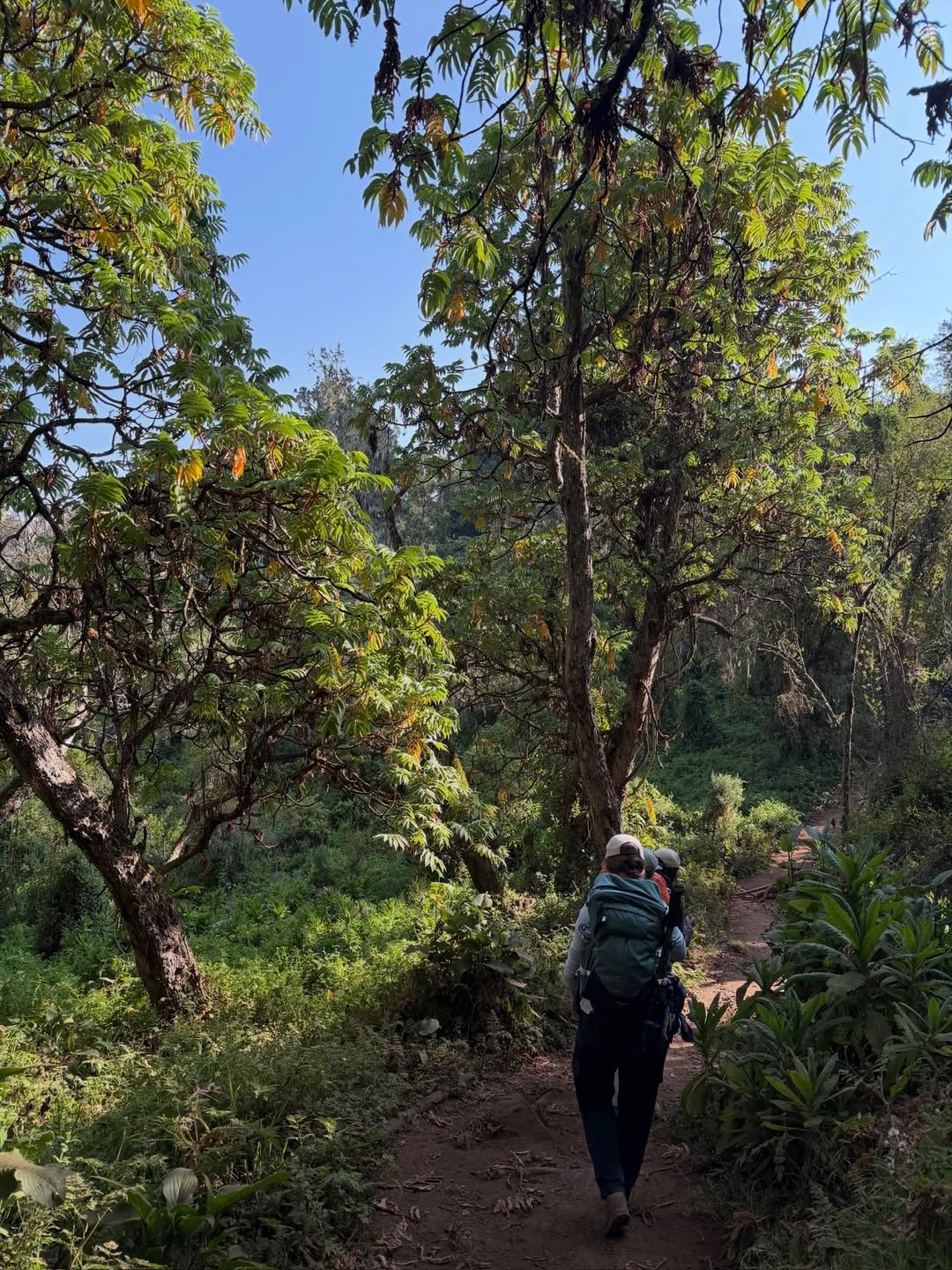
The trail climbs through enclosed montane forest to Machame Camp, crosses heather and moorland to the Shira Plateau, then traverses beneath Kibo through Lava Tower, Barranco, Karanga and Barafu. This is not a list of camps to collect. Each transfer changes the relationship between effort, elevation and sleep. The pace should remain deliberately slow even when the walking feels easy. Early restraint pays for itself later when the trail becomes colder, rougher and less forgiving.
It combines a strong climb-high, sleep-lower pattern with some of the mountain’s most varied scenery. The benefit is strongest when the itinerary retains enough days to use the landscape intelligently. Rest stops, optional acclimatisation walks and an unhurried arrival in camp are part of the route design. Removing a day changes more than the price: it changes how abruptly the body must respond.
The route is popular. Camps and the Barranco Wall can be busy, especially in the main dry seasons. A short itinerary magnifies both fatigue and altitude pressure. A responsible itinerary should name that weakness plainly. No route is universally best, and no route can guarantee acclimatisation.
Machame: the complete seven-day mountain itinerary
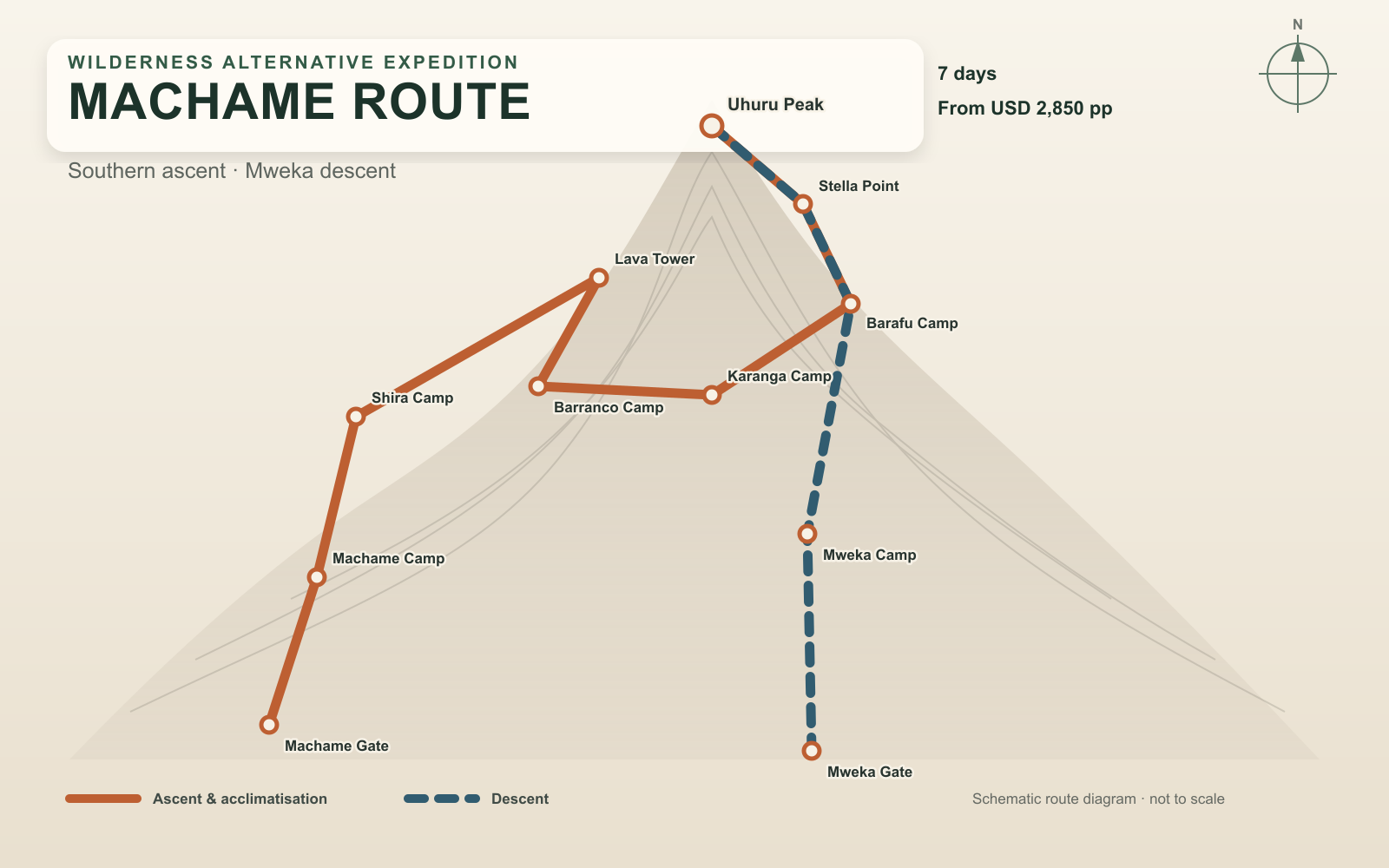
This is the full seven-day version of Machame. It retains the Karanga night and uses the Lava Tower excursion to improve the rhythm of acclimatisation. Arrival and departure days sit outside the seven mountain days.
Arrival in Moshi — briefing and equipment check
We meet you at Kilimanjaro International Airport when the transfer is included, settle you into the Moshi lodge and carry out a working briefing with the lead guide. Boots, waterproofs, sleeping system, headlamp, summit layers and duffel weight are checked while there is still time to correct a problem.
Day 1 — Machame Gate to Machame Camp
After park registration the trail enters humid montane forest. Roots, mud and rain can make this gentler-looking day slower than expected. The guide sets a measured pace while the crew establishes camp among the giant heather above the forest.
Day 2 — Machame Camp to Shira Camp
The forest thins into heath and open moorland. The trail climbs a rocky ridge onto the Shira Plateau, where Kibo, the Western Breach and the scale of the upper mountain begin to dominate the view. This is a shorter day than the summit stages, but the gain in sleeping altitude is meaningful.
Day 3 — Shira Camp to Barranco Camp via Lava Tower
We move into alpine desert and climb towards Lava Tower, around 4,600 metres, before descending to Barranco. The high point followed by a lower camp is one of Machame’s useful acclimatisation features. The day is long, exposed and often cold; eating and drinking remain part of the work.
Day 4 — Barranco Camp to Karanga Camp
The morning begins on the Barranco Wall. It is steep and requires hands in places, but it is a guided scramble rather than technical climbing. Beyond the wall the trail crosses ridges and valleys to Karanga. Keeping this night separates the wall from the move to high camp and gives the body another sleep near 4,000 metres.
Day 5 — Karanga Camp to Barafu Camp
A steady climb reaches Barafu on a stark ridge beneath Kibo. After lunch the priority is rest, hydration and organising every summit-night layer before darkness. The guide completes health checks and sets the departure time according to weather and the group’s pace.
Day 6 — Barafu to Uhuru Peak, then Mweka Camp
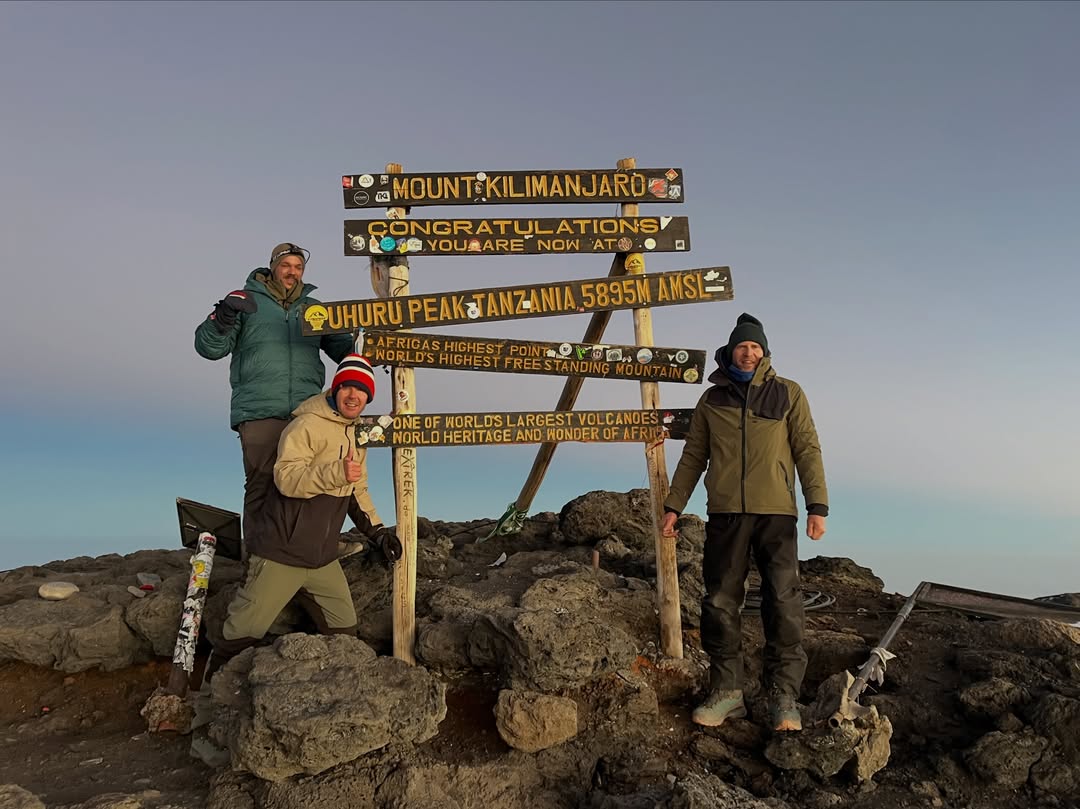
The summit climb starts around midnight. A slow ascent on scree reaches Stella Point on the crater rim, followed by the final traverse to Uhuru Peak at 5,895 metres when conditions and health allow. The summit is only the turn-around point: we descend past Barafu, eat and continue to the thicker air at Mweka Camp. Expect the longest and most demanding day of the expedition.
Day 7 — Mweka Camp to Mweka Gate
The final descent returns through forest to the park gate. Certificates are processed, the crew farewell and tip distribution are handled transparently, and we transfer to the lodge for a shower, food and rest.
Departure or onward Tanzania journey
After the post-climb night, transfer to the airport or continue into a carefully timed safari or coast programme. We avoid forcing a dawn road transfer immediately after summit day.
Acclimatisation on Machame
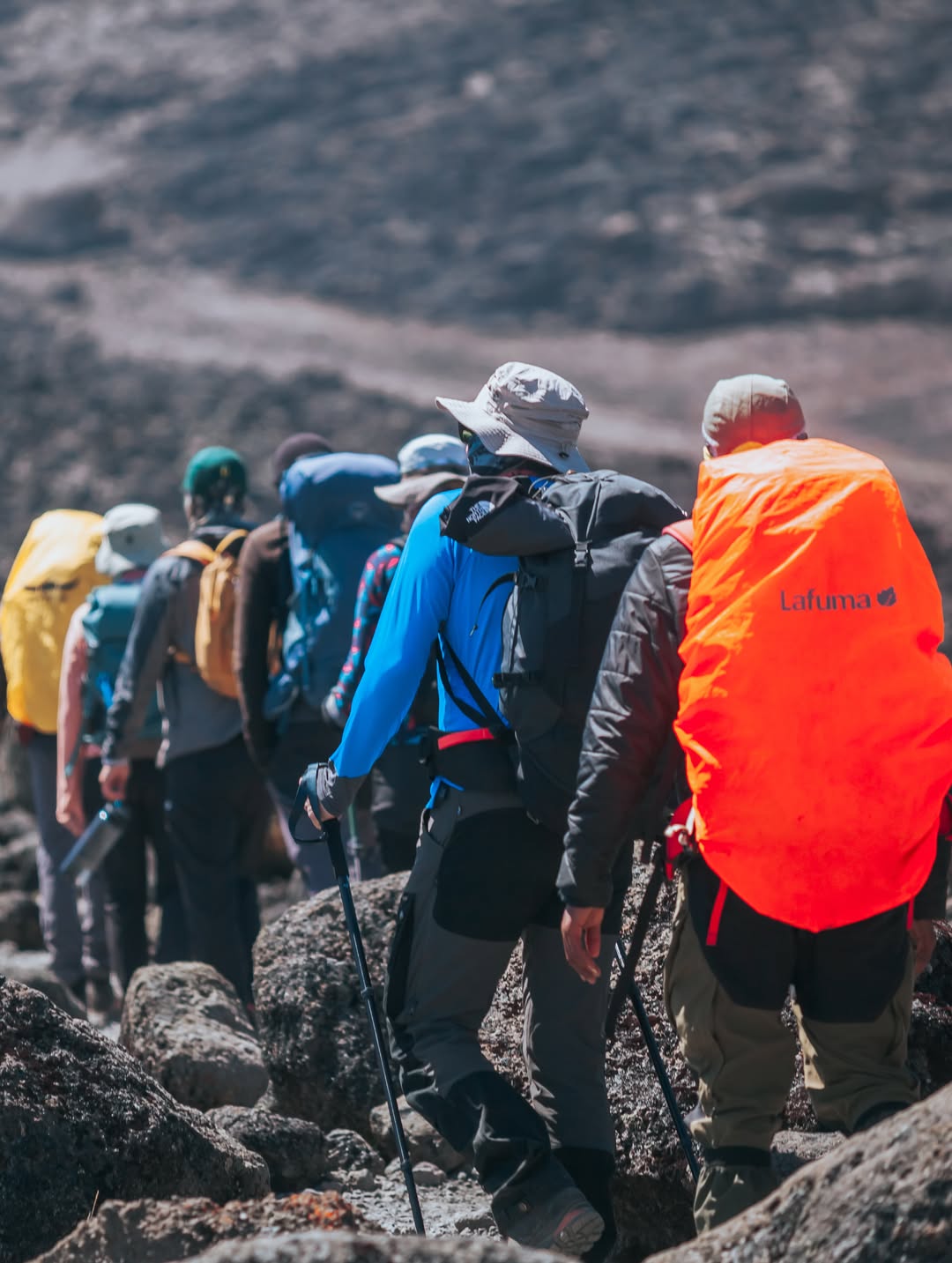
Fitness and acclimatisation are different. Strong legs help with repeated walking, but they cannot force the body to adapt to reduced oxygen pressure. The route’s number of days, daily height gain and opportunities to sleep lower after a higher excursion matter. So do recent illness, sleep, hydration, food and individual physiology.
Headache or poor sleep may occur, but symptoms still need to be reported. A worsening headache, repeated vomiting, poor coordination, confusion, breathlessness at rest or a wet cough require immediate guide attention. Continuing upward is never the automatic answer. Descent remains the decisive treatment when severe altitude illness is suspected.
On Machame, the central planning question is this: The route is popular. Camps and the Barranco Wall can be busy, especially in the main dry seasons. A short itinerary magnifies both fatigue and altitude pressure. The itinerary should answer that risk rather than hide it beneath a success-rate statistic.
Terrain, weather and camp life
Kilimanjaro crosses several ecological zones in a short horizontal distance. Lower trail may be wet and rooted; moorland is more open and exposed; alpine desert brings dust, strong sun and large temperature swings. Near the summit, wind and cold dominate. Rain can occur outside the recognised wet seasons, and fresh snow can alter the upper route.
Tents must be waterproof, maintained and correctly pitched. A private toilet tent may be carried if included in the operating programme; public facilities still vary. Meals are prepared by the mountain cook team and need to remain appealing as appetite falls. Treated water is managed from route sources where available, with higher camps requiring more careful planning.
Who should choose Machame?
first-time high-altitude trekkers who are well trained, comfortable camping and willing to choose seven days rather than chase the shortest headline. That recommendation assumes adequate training, appropriate medical preparation and a willingness to follow a guide’s pace. It does not mean every traveller matching the description will acclimatise well.
Travellers comparing Machame with another route should examine the actual mountain days, not total holiday nights. Pre-climb and post-climb lodge stays are important, but they do not replace acclimatisation time on the mountain. Compare camp sequence, summit approach, private-toilet inclusion, group size, crew welfare, emergency systems and equipment before comparing price.
Photography on the route
The strongest images show the route in its environment. For Machame, prioritise forest atmosphere, the Shira Plateau, Lava Tower, the Barranco Wall in context and wide dawn frames on the crater rim. A long lens can compress ridges and isolate Mawenzi or Kibo; a wider lens shows the small scale of climbers against the massif. Batteries drain quickly in cold, so summit-night power should be carried close to the body. Camera decisions must never slow the group in exposed terrain or delay descent from the summit.
Price and what the expedition includes
Guide price: USD 2,850 per person. The final per-person price reduces as the number of confirmed climbers in the private group increases, because transfers, guide leadership and shared camp systems are distributed across more people. We quote the exact group rate after dates, party size and any private-room or equipment requirements are confirmed. We do not cut acclimatisation days or porter welfare to manufacture a cheaper headline.
The core programme includes airport transfers tied to the itinerary; the pre-climb and post-climb lodge nights in Moshi; guide briefing and equipment check; park, camping or hut and standard rescue fees applicable to the booked programme; professional mountain guides; cook and porter crew; crew wages; all mountain meals; treated drinking water; maintained mountain tents, a mess tent and a private toilet tent for the group; pulse oximeter observations; a mountain first-aid kit; emergency oxygen carried for guided use; and operational support for an early descent.
International flights, visas, travel and high-altitude medical insurance, personal trekking equipment, optional rentals, tips, alcoholic and bottled soft drinks, personal purchases and any safari or coast extension are excluded unless the written quotation says otherwise. Government tariffs can change; a quotation records what is included for its validity period.
Ethical porter care is part of the route
Porter loads are checked before departure and managed through the climb. We do not overload a porter to protect a margin; if guest baggage, water or group equipment requires another crew member, the crew plan must change. Porters need adequate food, treated water, shelter, protective clothing, rest and medical attention. Wages and the tipping process are explained clearly, and tip distribution is handled where the group can see it.
A well-run Kilimanjaro climb is visible in the ordinary details: tents reach camp without one person carrying an abusive load, crew meals are not an afterthought, guides can recommend descent without commercial pressure, and the final price reflects the people who make the expedition possible.
Preparing in Moshi
Wilderness Alternative’s small operational presence in Moshi supports the practical work before departure: guide contact, transfer coordination, equipment checks, route briefing and final logistics. Arrive with enough time to recover from travel and deal with delayed luggage. Rental boots or critical summit layers should never be accepted without trying and inspecting them.
The briefing should cover pace, water, meals, baggage limits, tipping, symptoms, evacuation and what the guide expects from each climber. Porter loads must be controlled, wages and tips handled transparently, and crew given adequate food, shelter, clothing and care. Wilderness Alternative will name a formal porter association only after its exact relationship has been confirmed.
Frequently asked questions
Is Machame a technical climb?
The standard route is a high-altitude trek. Ordinary movement does not require ropes, but altitude, weather, rough ground and the long summit night make it serious. The Western Breach and technical Mawenzi are separate undertakings.
What is the shortest sensible itinerary?
Seven mountain days is the balanced version; six days is possible but removes the Karanga night and useful acclimatisation time. Shorter is not automatically impossible, but it reduces margin and should not be presented as equal simply because the summit is the same.
When should I climb?
January to early March and June to October are commonly selected. Weather is never guaranteed. The northern side can be relatively drier in some wet patterns; the southern forest can remain humid in any month.
Where do we descend?
Barafu is the high launch camp. The night ascent reaches Stella Point on the crater rim before continuing to Uhuru Peak, then descends through Barafu and the Mweka corridor. Mweka should be understood primarily as a descent route, not marketed as an additional ascent choice.
Is the summit guaranteed?
No. Health, weather and acclimatisation decide. A safe descent is always more important than the summit.
Plan Machame as an expedition
Tell us your previous altitude, trekking experience, preferred dates, group size and whether you intend to continue on safari. We can then decide whether Machame genuinely suits the traveller, or whether another route provides a better margin. The answer should come from the shape of the mountain, not from the route currently being discounted.
Useful pages before you decide
Compare Machame with the Lemosho Route for a quieter western start, or the Northern Circuit for more days and a longer traverse.
You can also compare all seven Kilimanjaro routes, understand what happens on summit night and prepare with the Kilimanjaro packing list.